

Napa, CA — [Dec. 4, 2025] — The Wine Market Council (WMC) announced this week the results of its 2025 U.S. Wine Consumer Benchmark Segmentation Survey, revealing a major shift in the U.S. wine-drinking landscape. Millennials have officially overtaken Baby Boomers as the largest group of wine consumers, even as overall wine consumption continues to decline.
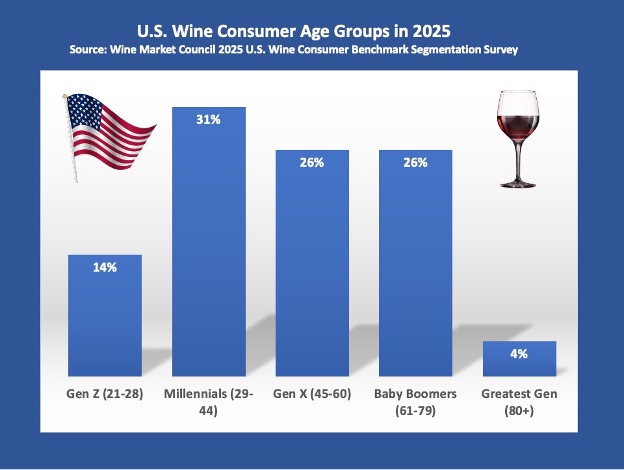
The survey, conducted every one to two years since 1997, is one of the largest and longest-running U.S. wine consumer studies in the world. The 2025 sample included nearly 5,000 U.S. adults over the age of 21, balanced to the U.S. census for age, income, education, gender, and ethnicity. It found that 31% of wine drinkers are now Millennials, surpassing Baby Boomers at 26%, whose share has dropped significantly from 32% in 2023. Gen Z’s share also climbed from 9% to 14%, despite only half the cohort currently being of legal drinking age.
“These findings show both opportunities and challenges,” said Liz Thach, President of the Wine Market Council, who presented the results alongside Research Director Christian Miller during a recent webinar for WMC members. “We’ve seen gains among Millennials and Gen Z; however, the industry is concurrently experiencing a decline in overall wine consumers.”
“What is interesting about this change is that despite all the talk about young consumers reducing alcohol, the largest erosion we found was in Baby Boomers – consumers over 60 years of age,” stated Christian Miller.
Decline in Wine Drinkers, But Positive Progress on Other Fronts
Although younger cohorts are increasing their participation, the survey shows a drop from 34% to 29% in legal drinking age Americans who say they consume wine at least every two to three months.
This shift means that there are now 76 million American adult wine consumers, approximately nine million fewer adult wine consumers compared to 2023. It also reflects what is happening in the broader alcoholic beverage market, with beer, spirits, and wine sales all experiencing declines in the past year.
“These numbers are not surprising, because we knew that Baby Boomers would eventually decrease alcohol consumption as they aged. However, it is challenging, and suggests that the global wine industry needs to be more innovative in learning how to connect with younger generations,” stated Thach.
“On the positive side, the study shows that Gen Z are now enjoying wine more frequently than they did two years ago,” added Miller. “More additional good news is that the wine category has made considerable progress correcting its ethnic skew, with the percentages of non-Hispanic White, Black, and Asian Americans who drink wine now close to matching their share of the adult population.” Furthermore, the number of men who reported drinking wine increased from the prior survey.
Millennials Drive Today’s Market—but Also Present New Challenges
Now entering their thirties and early forties, Millennials are entering life stages associated with higher beverage alcohol spending — marriage, peak earnings, family formation, and homeownership. However, their values, priorities, and preferences differ notably from prior generations.
“Despite being the largest wine-consuming cohort, Millennials also represent a significant, growing segment of those who drink other categories of alcohol and abstainers,” stated Miller.
Keychallenges include 35% who say they do not like the taste of wine, and 39% prefer the taste of other alcoholic beverages. Other WMC research has linked this to difficulty in identifying which wines deliver which flavors.
Thach characterized this as a “big wake-up call” for the industry, emphasizing the need for clearer communication about flavor, style, and what’s inside the bottle. Consumers are reluctant to spend on a wine if they are uncertain about how it will taste.
Shifting Preferences: Flavor, Versatility, and Sparkling Growth
Younger generations diverge notably from Baby Boomers and Gen X (ages 45-60) in wine preferences. Whereas Boomers prefer big, bold reds like Cabernet Sauvignon, and Gen X appears to enjoy all styles, Millennials and Gen Z have different tastes. Some of the trends include:
- Millennials prefer merlot, pinot noir, chardonnay, muscat, rosé and sweet rosé
- Gen Z prefer grenache, chardonnay, muscat, rosé and sweet rosé
- Both younger generations are far more likely to drink sparkling wine than Boomers
- Gen Z favors U.S.-made sparkling
- Millennials prefer Prosecco
- Both cohorts drink more Champagne and Cava than older generations
Changing Occasions: Wine Seen More as “Special” Than Everyday
One of the most surprising findings, according to Thach and Miller, is the shift in the primary reasons consumers choose wine. Over 40% now say wine makes occasions feel more special, compared with past surveys where relaxation at home was the leading driver.
“Weekday dinner and relaxing-at-home occasions have declined,” said Thach. “We need to do a better job communicating that wine can be enjoyed in moderation as part of everyday life.”
This finding corresponds with a 2024 study that WMC conducted on young adults. “We found that young adults do like wine; they just save it primarily for special occasions,” added Thach.
Wellness Trends: Mood, Energy, and Transparency Matter
Health remains a key factor in the decline of alcohol consumption, but motivations differ across generations. In the past year, 24% of Gen Z and 21% of Millennials changed the type or amount of alcohol they drink to improve mood, sleep, or energy, verses 11% of Gen X and 5% of Boomers.
“It’s more of a ‘wellness’ than a ‘medical issue,’ Miller explained. “For younger drinkers, it’s about how alcohol makes them feel rather than medical advice per se. Just 12% of those under 45 had read about studies of the negative impact of alcohol on health, whereas 22% had changed alcohol consumption to improve mood, sleep, or energy, and far more were reducing consumption of sugar, additives, and processed foods.”
Furthermore, Americans’ focus on health and wellness was obvious in the survey, in that 27% of all consumers in the study reported changing their diet to reduce sugar and 20% said they reduced or avoided additives or processed food/drinks.
Thach emphasized the importance of transparency in addressing these concerns. “Many consumers believe wine has high sugar or unnecessary additives. If we want to keep these younger generations engaged, we need to provide accurate information and increase transparency.”
Complete Study Report Available Soon
The Wine Market Council plans to release to its members the complete report on the 2025 U.S. Wine Consumer Benchmark Segmentation Survey in a few weeks, including data from questions covering changes in consumption by category, wine purchases by channel, variety, price, and region, wine tourism, cannabis and wellness factors, analyzed by various demographic segments.
The Wine Market Council is a leading non-profit organization dedicated to advancing the wine industry through research, insights, and education. The Council provides ongoing consumer and trade studies to help members better understand evolving trends and market dynamics. For more information, please see https://winemarketcouncil.com/.